THE NEUROSCIENCE BEHIND HANDS-ON CREATIVITY
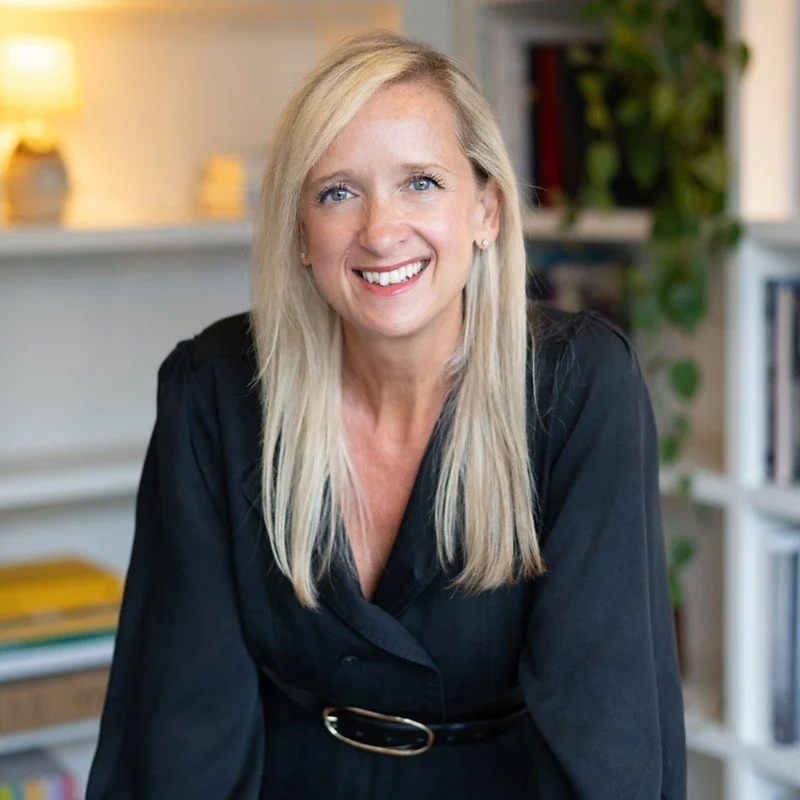
Claire Koryczan - Founder of Imagine Beyond
Claire Koryczan is the Founder of Imagine Beyond, a leadership and learning consultancy focused on creativity, entrepreneurial mindset, and purposeful leadership. With 25+ years of experience, she works with leaders and teams to navigate change, build self-awareness, and unlock human, and team potential.
"Beta brainwave mode enables you to be highly focused and productive." Claire says, "But in this mode, there isn't much space to imagine and think creatively.... ...when you tap into the slower 'alpha' brainwaves the brain connects the dots and solves problems."
This is where hands-on creative workshops (like those offered by us at Well–Crafted) step in. By removing screens and engaging the senses, they act as a neurological reset.
Executive functioning relaxes and works in the background, which is where you get creative breakthroughs. “You’re getting people to make and play,” she continues. “That automatically taps into a different state of mind."
Claire believes positioning craft-based workshops as experiential learning is key. “These are deeply human experiences,” she says. “You’re building new skills, tapping into creativity, and sharing energy in the room. AI can do many things, but it can’t replicate how it feels to be physically present with others, learning together."
While virtual participation helps teams stay accessible and inclusive, Claire stresses that the real magic happens when people gather in the same space: navigating challenges side by side, sharing laughter and flow, and noticing subtle cues and sparks of connection we can’t get through screens.
“The neuroscience speaks to HR. The human connection speaks to everyone.”
Keeping creativity alive in the age of AI.
As AI becomes embedded in daily work flows, Claire sees a risk: “We can’t allow AI to become the default. It’s powerful: I use it all the time, but if we outsource all exploration to these tools, the danger is that AI becomes the default and we weaken our ability to think for ourselves We've seen it in the recent study by MIT, and we know from neuroscience the 'neurons that fire together, wire together' so the more we train our brains to become reliant on these technologies, the less those neural pathways for critical thinking and problem solving strengthen.”
Workshops like Well–Crafted help us maintain and stretch our critical and creative muscles. “In a world increasingly dominated by technology, we have to ask: what is human value? What is human purpose? Creativity is part of the answer.”
A strategic lever for wellbeing & productivity
For Claire, the business case is clear: investing in creativity improves wellbeing, strengthens human relationships and, ultimately, enhances contribution and productivity. Creativity is our advantage in this era." Looking forward As organisations navigate rapid change, she encourages Well–Crafted - and its clients - to keep evolving: Because when we take an intentional moment to slow down and reconnect with our imagination, we create better work.
Q: What leadership traits will define a workplace that thrives in 2026 and beyond?
Agility, curiosity, customer-centricity, tenacity, courage, innovation and creativity are no longer optional. They’re core leadership behaviours for navigating change in 2026, and come from an entrepreneurial mindset, one that finds the opportunity in challenge and the way to overcome obstacles.
Q: Organisations are moving from experimenting with AI to asking how it can reshape roles, mindsets and workflows. In your view, what does this transition mean for workplace culture and how should HR and L&D be responding now?
I see culture as the actions and behaviours of the leaders that influence the rest of the organisation. Underpinned by values - the things that are deemed important and rewarded. Since the COVID-19 era, workplace culture has shifted significantly. It's more about our individual worlds, as the work environment transitioned from the office to our homes. Right now, we are in another shift with the acceleration and integration of AI platforms and systems (in particular, generative AI), and the explosive uptake in just the last two years. We are moving towards an augmented culture that combines work, home and AI. And what makes this so different now from any other transformative time is that (Gen)AI is using natural language to interact with humans in human-like conversations, giving the impression of a “team member”. The watch-out is that we don't anthropomorphise the technology when it responds with human-like qualities. There are two crucial areas to consider for HR and L&D specifically in relation to this integration:
1. The need for upskilling purposefully and thoughtfully - so that employees are aware of the pitfalls (biases, hallucinations, data sources, unrealistic relationships, etc) and benefits (productivity gains and speed, etc).
2. How the integration of human-like collaborative tools brings about less actual human interaction, thus eroding communication and collaboration skills. So we must be even more intentional about fostering human collaboration.
Q: How possible do you think it is over our lifetime AI will develop imagination, empathy and collaboration?
There are many parallels between how AI operates and the human brain. Take dreams as an example of the human imagination at work. Dreams are created in the mind and originate from the data stored in our memories, remixed into new experiences, much like a virtual reality scene which uses AI to control aspects of the game. Generative AI uses empathetic words, which evoke the impression of empathy, but this is different from the feeling of human empathy, and feeling seen and heard by a colleague, friend, or boss, because its demonstrated not just through words, but through energy, non-verbal communication, and physical actions (like a hug, for example). Human-centred skills like creativity, curiosity, and courage enable us to navigate change, and in many ways, the entrepreneurial mindset is where many of these resourceful skills live. This mindset is a survival skill for the road ahead. The more we tap into those alpha brain waves and become more creative, the more adaptable we become.
Q: You’ve mentioned that AI-driven systems carry biases and require transparency. For companies looking to integrate AI into people-centred practices, what are the most common pitfalls you see around culture, ethics and communication?
Be transparent and open with your teams about how you are using these tools. Share examples of how you prompt them. Discuss the pitfalls of the data it's trained on, how to validate the outputs, and always fact-check by requesting the sources. Remember, these tools are built to be finely tuned and personalised to you, designed for maximum engagement, and will reinforce what you input, and will give different outputs to each individual. Regarding ethics, you may be familiar with the Deloitte 'workslop' case study, where hallucinations and non-existent citation sources were included in a recent report. This is a cautionary tale for us all regarding the ethics of using these systems.
Q: For HR or Learning & Development professionals reading our trend report, what one actionable step would you suggest they take to prepare their organisations for the changing workplace of 2026?
As organisations gain maturity in their integration of AI, from experimentation to implementation, ensure there are best practices on how to use these tools. I've heard countless stories of people using free AI tools and uploading confidential personal and company data. This is an absolute no-go. Be clear about how your people are expected to use these tools. Train them in AI fluency so they understand what's possible to optimise their work, and encourage people to share what's worked and why, so that everyone can learn from one another. Be curious, have a growth mindset and an openness to learn because things are constantly changing, and will continue to do so.
To learn more about Claire and Imagine Beyond, visit the website.